The most important generative AI business transformation 2026 has produced is not a new model. It is a new standard.
AI is no longer being asked to draft, summarize, or suggest. It is being asked to act, execute, and deliver against real business outcomes. Google, SAP, DXC, and Infor all made significant moves between October 1 and October 18, 2026, and each one reflects exactly that shift.
This edition of The AI Advantage covers five stories from the past three weeks. Each one features a named company. Each one is grounded in what businesses actually need. And each one is a direct signal for where generative AI business transformation 2026 is heading next.
The standard has changed. The question is no longer whether AI is ready. It is whether your business is building the context, governance, and specificity needed to capture what it offers.
For years, businesses have asked generative AI to draft emails, summarize documents, generate ideas, and answer questions. Google’s latest agentic Gemini announcement points toward something more consequential: AI that can work toward an objective using business tools.
What does Google’s agentic Gemini announcement mean for businesses?
Instead of responding to prompts, Gemini can now be given a goal and a set of tools, and it will determine the steps needed to reach that goal. It can read files, query data, call APIs, and update records, working through a task the way a capable employee would rather than just generating text about it.
Google reported that nearly 90% of Fortune 100 companies were using Gemini Enterprise at the time of the announcement. That is a company-reported adoption figure, not evidence that those businesses have achieved equivalent productivity gains. The gap between adoption and outcome remains the central challenge of enterprise AI in 2026.
What this means for you: The shift from conversational AI to agentic AI is the most important architectural change available to businesses right now. But adoption is not transformation. The organizations getting real value from agentic AI are the ones that have connected it to specific, measured workflows with clear accountability. If your team is using Gemini Enterprise, the question worth asking is: what is it actually completing, and how are you measuring that?
AI is only as useful as the business context behind it. A customer does not care that a company has a sophisticated AI model. The customer cares whether a quote is accurate, an order arrives on time, and a service commitment is fulfilled.
What is SAP doing with generative AI and business processes?
SAP’s Joule assistants are designed to bring business context into workflows spanning marketing, commerce, sales, service, finance, and operations. Rather than adding AI as a layer on top of existing systems, SAP is embedding it into the processes that determine what a business actually delivers to its customers.
The distinction matters. A general-purpose AI model can write a convincing response about a delivery delay. A model connected to your ERP, inventory, and logistics data can tell the customer when their order will actually arrive and take the steps needed to make that happen.
What this means for you: The businesses seeing the strongest AI ROI right now are the ones connecting AI to the systems that run their operations, not just the tools their teams use to communicate. If your AI deployment is helping people write better emails but not touching the processes behind your customer promises, that is a significant opportunity sitting on the table.
The real test for AI agents is whether businesses can trust them in production. When a business system fails, the cost is not limited to the time spent investigating it. Employees may be unable to work, customers may lose access to services, and technical teams may spend hours identifying the underlying problem.
What is the DXC and LangChain partnership about?
DXC Technology announced a partnership with LangChain to advance governed agentic AI for mission-critical IT operations. The collaboration focuses on building AI agents that can identify, diagnose, and respond to IT incidents, while maintaining the governance frameworks that enterprise IT requires.
The emphasis on governance is the critical distinction here. Deploying AI agents in IT operations without clear accountability structures is how you get rising incident rates rather than falling ones. DXC and LangChain are building the oversight layer alongside the capability layer, not as an afterthought.
What this means for you: If your organization runs any IT operations, customer-facing systems, or business-critical infrastructure, governed AI agents represent a meaningful opportunity to reduce incident response time and resolution cost. The governance question is not a blocker. It is the design requirement. Any AI agent deployment in a critical environment should have a clear human escalation path, outcome metrics, and a defined rollback procedure before it goes live.
Why might a smarter model still fail to understand your business?
A general-purpose generative AI model can write a convincing explanation of a manufacturing process. That does not mean it understands the company’s actual production constraints, supplier agreements, quality requirements, or inventory position.
What is Infor warning about with generic AI?
Infor’s research highlights the gap between what a general-purpose model knows about an industry and what it needs to know about a specific business within that industry. Domain-specific knowledge matters enormously when AI is being used to make or recommend operational decisions. A model trained on the internet knows what manufacturing looks like in general. It does not know your tolerances, your supplier lead times, or your contractual obligations.
This warning connects directly to findings from earlier in 2026 showing that enterprise AI leaders are moving away from monolithic models toward compound AI systems built around specific business problems. Infor’s research confirms why: specificity is not a nice-to-have. It is the difference between AI that informs decisions and AI that actually improves them.
What this means for you: Before expanding your AI deployment, assess whether the model you are using has access to the business context it needs to be useful in your specific situation. General-purpose AI is a powerful starting point. But the organizations achieving durable ROI are the ones feeding their AI with proprietary data, institutional knowledge, and domain-specific context that generic models simply do not have.
The next AI business opportunity may be what companies contribute to it.
Generative AI does not create value in isolation. It depends on information, expertise, intellectual property, and access to trusted sources. Google’s expanded partnerships with news publishers offer a revealing example of how content inputs can become part of a commercial arrangement.
What is Google doing with news publishers and AI?
CNN, Axios, the Financial Times, and other publishers have joined Google’s AI news program, licensing their content for use in AI-generated responses in exchange for commercial compensation. The model matters for any business that produces original content, research, proprietary data, or specialized expertise.
As AI platforms become the primary interface through which people access information, the organizations that have established licensing arrangements and citation authority will be systematically favored over those that have not. This is not a future trend. It is happening now.
What this means for you: If your business produces original content, research, or specialized expertise, the question is whether that content is being cited by AI systems or filtered out of their responses entirely. Generative Engine Optimization is not just a marketing discipline. It is an infrastructure decision about whether your business shows up in the AI-mediated information environment that is increasingly where your customers are finding answers.
If Your Business Stops When You Stop, You Have a Job with Rajesh Nagjee
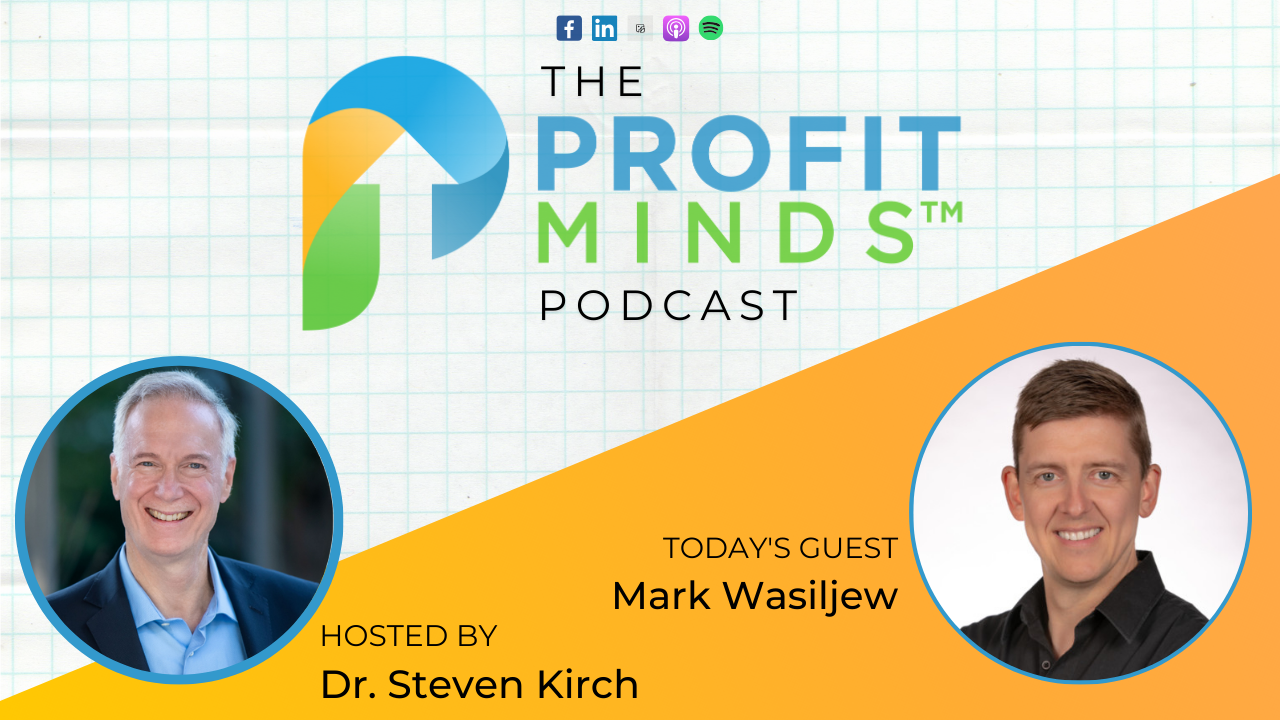
In Episode 151 of The Profit Minds Podcast, Dr. Steven Kirch sits down with Rajesh Nagjee, CEO, mentor, business physicist, and creator of the CEO Freedom OS.
If your business stops when you stop, you do not have a business. You have a job. And YOU are the bottleneck that nobody warned you about. This conversation is for every business owner who wants to build something that works without them being the engine behind every decision.
Click Here to Watch the Podcast
AI Is Powerful. But Are You Using It Wisely?
Generative AI can transform the way we work. But are businesses moving fast enough to ask the right questions?
Our AI guru, Suzanne Coconato-Kirch, has published Practical AI Ethics: Six Questions to Ask, a must-read guide to navigating the opportunities and risks of AI in business. From protecting confidential information to spotting bias and preserving human judgment, these six questions challenge businesses to think beyond productivity and build AI practices grounded in trust, responsibility, and sound decision-making.
What this means for you: Before putting AI to work, ask yourself: Is it accurate? Is our data protected? Are we using it fairly and responsibly? And are humans still in control?
Smart AI adoption starts with smart questions.
Read Suzy’s Article: Practical AI Ethics — Six Questions to Ask
Twelve weeks. One stage a week. It ends with something that is still working six months later.
The AI Transformation Method™ is a 12-week program that equips every employee to produce every role deliverable faster, easier, and better with AI. It runs across a whole organization, and it runs just as well for one person working alone.
WE GUARANTEE A POSITIVE ROI.
Know someone who would benefit? Forward this invitation to help others transform their business.
At Profit Minds, AI isn’t the threat. Falling behind is.
We help business owners, career coaches, and professionals adopt AI effectively, efficiently, and ethically no matter where you’re starting. Our approach is hands-on, not theoretical. We assess where you are, train your team with real workflows, and support you as AI continues to evolve.
Through three pillars:
We don’t want AI to replace your brain. You still gotta think.
Thank you for being part of our forward‑thinking community. Share this edition with a leader who needs to understand where enterprise AI is headed in 2026.