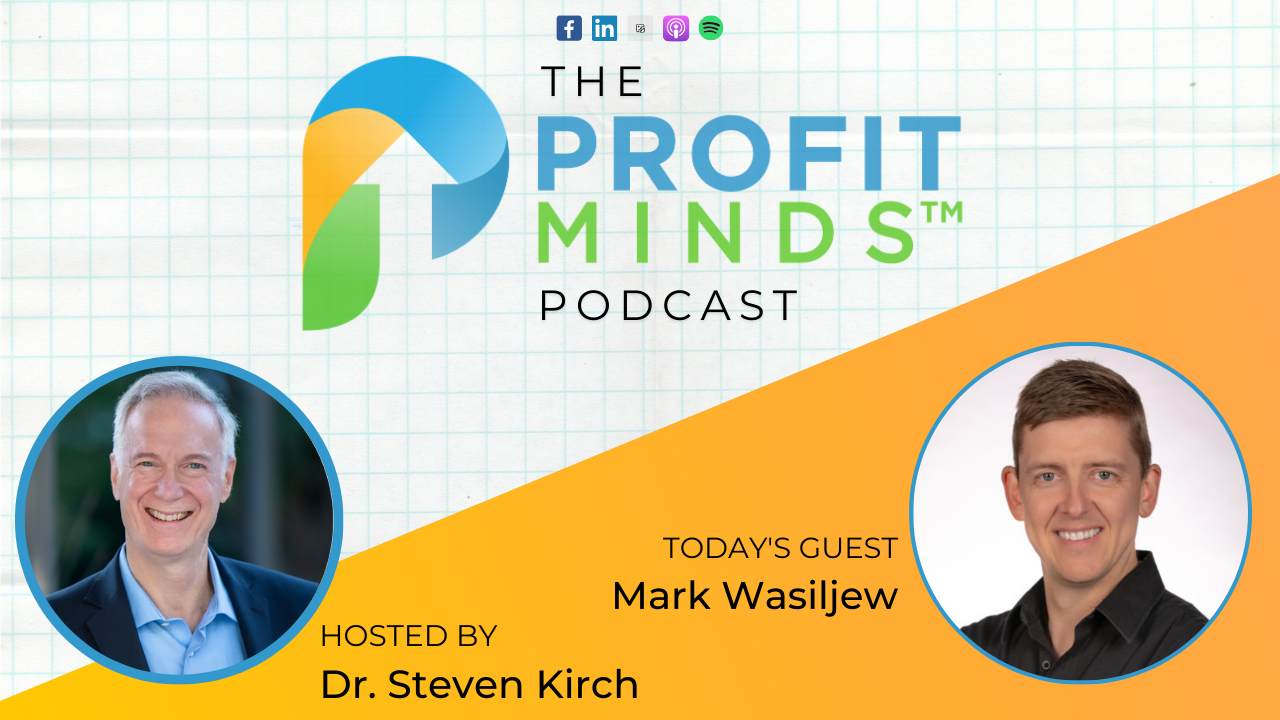
Understanding AI copyright law 2026 is no longer optional for any business creating content with artificial intelligence. In Episode 156 of The Profit Minds Podcast, Dr. Steven Kirch sits down with return guest Nadia Davari – an entertainment and tech lawyer based in Los Angeles with over 25 years of experience navigating the intersection of technology, creativity, and the law.
A native Angeleno who earned her undergraduate degree from UCLA and her law degree from USC, Nadia has been on the front lines of every major tech disruption in entertainment law: from Napster dismantling the music industry, through the Netflix streaming pivot, and now into the age of AI. On March 2, 2026, the Supreme Court settled the most important copyright question in AI history. And most business owners still have no idea it happened.
In this episode, Dr. Kirch and Nadia Davari break down the most critical developments in AI copyright law 2026 and the practical steps every business owner must take right now:
Nadia Davari started her legal career in Los Angeles while the entertainment industry was being turned upside down by the internet. She graduated from UCLA as an undergraduate and USC for law school, joining an entertainment law firm during her studies and never leaving. What kept her there was the same thing that makes entertainment and tech law so demanding: it never stops moving. Napster disrupted how music was made, consumed, and monetized.
Streaming ended the DVD business and created an entirely new one. The entertainment guild strikes that followed the pandemic drove some of the most consequential AI legislation California has ever passed. And now AI itself is rewriting the legal landscape for every business that creates content, writes code, designs products, or serves clients in any professional capacity. Nadia handles contracts, deal negotiations, trademarks, and licensing for clients across film, music, fashion, and technology – industries that sit at the sharpest edge of AI legal disruption.
The most important development in AI copyright law 2026 is not a new bill. It is a Supreme Court decision that most business owners have not heard about.
In Thaler v. Perlmutter, the Supreme Court on March 2, 2026 refused to hear the challenge to the lower court ruling, cementing that copyright protection requires a human creator. AI alone cannot hold a copyright. As Nadia explains in the episode: for certainty, we can say that to register a copyright in a body of work, you need to have a human being creating it. That is now settled.
But this ruling created a new and urgent battleground: how much human input is enough? If you are prompting AI at every stage of the creative process – directing it, refining it, making the editorial decisions – does that qualify? This is the question courts and contracts will be resolving throughout 2026 and beyond. And it is exactly why the prompt audit trail has emerged as a critical new legal concept.
One of the most important things Nadia introduces in this episode is the prompt audit trail – and it is already appearing in commercial contracts.
A prompt audit trail is a documented record of the specific human inputs and decisions made at each stage of an AI-assisted creative process. It creates a traceable pathway from the human creator’s intent through every prompt and decision to the final output. Nadia describes it directly: you can record and show what your human input has been – the specific prompting that shows the pathway to the final product – and it safeguards your work.
For content creators, developers, marketers, and anyone using AI in their production pipeline, this has immediate practical implications. Without a prompt audit trail, your claim to human authorship and your copyright protection become significantly harder to defend.
Beyond the copyright question, Nadia walks through a range of legal risks that are not theoretical. They are active, growing, and already affecting businesses in 2026. Lawyers who upload client data to AI tools risk waiving attorney-client privilege. This is not a gray area. Medical professionals face parallel exposure under HIPAA.
In the New York Times vs. OpenAI litigation, it was proven in discovery that large language models routinely memorize and reproduce verbatim copies of their training data – meaning AI-generated outputs can be copying unlicensed content, and that liability flows downstream to whoever uses the tool.
Prompting AI to generate content in the style of Drake or a logo in the style of Nike creates trademark exposure. In California and New York, publicity rights extend this risk further and in California, those rights cover deceased individuals and their estates as well.
The Takedown Act, signed into law May 19, 2025, entered full criminal enforcement on May 19, 2026, criminalizing the intentional publication of non-consensual intimate AI-generated visual material. And the EU is already ahead of the US, requiring that all AI-generated content be clearly marked and digitally detectable as artificial – with fines attached for violations.
Get a FREE 15-minute consultation with Nadia. Simply email Nadia and mention you are a Profit Minds Podcast listener to claim your free consultation.
👉 Email: nadia@nadiadavari.com
Dr. Steven Kirch is the creator of the Profit Minds™ Growth System, which helps entrepreneurs and professionals accelerate profits through productivity, scalable systems, and AI-powered business strategies.
Never miss an episode! Subscribe to The Profit Minds Podcast now for conversations with top business leaders, financial experts, and innovators who help you grow and scale smarter and who expose critical truths wealth destroyers.
Available on all major podcast platforms.